
How Do You Know if Spinal Decompression Is Working?
When someone begins spinal decompression for a disc-related condition, one of the first questions they naturally have is:
How will I know if it’s actually working?
The obvious answer might seem to be pain.
If your pain decreases, the treatment must be working.
Pain improvement certainly matters, but it isn’t the only way Dr. Venn evaluates progress.
A patient being treated for a herniated or bulging disc, sciatica, or another disc-related condition may have several different symptoms and functional limitations before beginning care. Those can give us multiple ways to determine whether the condition is changing.
At Venn Chiropractic and Wellness Center in Frisco, Dr. Jason Venn looks at the patient’s overall pattern of improvement rather than relying on a single number on a pain scale.
Depending on the condition, signs of progress may include:
- Less intense pain
- Pain occurring less frequently
- Radiating symptoms traveling less distance into an arm or leg
- Reduced numbness or tingling
- Improved ability to sit
- Improved walking or standing tolerance
- Better sleep
- Fewer or less severe flare-ups
- Improved spinal movement
- Greater ability to work, exercise, drive, or perform normal daily activities
The most meaningful signs can be different for every patient.
Someone who initially couldn’t sit through a 30-minute commute without severe leg pain may consider driving comfortably a major improvement.
Another patient may still have some lower-back discomfort but notice that the severe pain that previously traveled all the way into the foot no longer does.
That is why progress should be measured against the problems the patient actually had when treatment began.
What Is Spinal Decompression Trying to Accomplish?
Spinal decompression is commonly used at Venn Chiropractic for appropriately selected patients with disc-related conditions such as herniated or bulging discs, sciatica, degenerative disc problems, and certain types of nerve-related neck or lower-back pain.
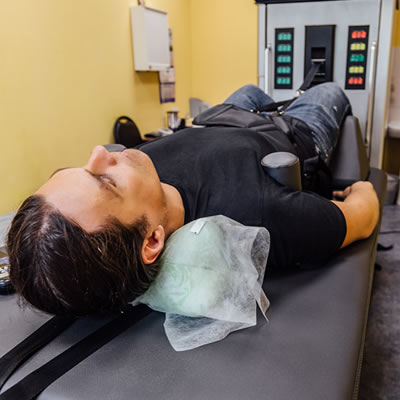
The treatment uses controlled decompression-and-release cycles to create a pumping action at the involved disc.
Rather than applying one continuous pull, the treatment alternates through carefully controlled cycles.
The goal is to reduce mechanical stress on the involved disc and surrounding nerve structures while creating conditions that may support the healing process.
But spinal decompression is not appropriate for every person with back or neck pain.
Before recommending it, Dr. Venn evaluates whether the patient’s history, symptoms, examination findings, and when appropriate, imaging, indicate that a disc-related condition is likely contributing to the problem.
Patients who want to understand the treatment itself can learn more about spinal decompression in Frisco.
Does Spinal Decompression Have to Eliminate Pain Immediately to Be Working?
No.
Some patients notice changes relatively early in care. Others improve more gradually.
The amount of time a condition has been present, the severity of the disc problem, whether a nerve is involved, the patient’s physical demands, and other individual factors can all affect how someone responds.
This is especially important with chronic problems.
A patient who has experienced months or years of symptoms should not necessarily expect the condition to behave exactly like a recent, uncomplicated episode of back pain.
Dr. Venn looks for a trend.
Are symptoms becoming less intense?
Are flare-ups occurring less frequently?
Can the patient tolerate activities that previously caused symptoms?
Is radiating pain changing?
Is function improving?
Those changes can provide a much better picture of progress than asking whether the patient is completely pain-free after a particular treatment.
What Does Improvement in Radiating Pain Look Like?
When a disc problem irritates or compresses a spinal nerve, pain may travel away from the spine.
A lumbar disc problem may produce pain into the buttock, hip, thigh, calf, or foot. A cervical disc problem may cause symptoms that travel into the shoulder, arm, or hand.
As treatment progresses, Dr. Venn pays attention not only to how intense the pain is, but also to where the pain is occurring.
For example, imagine a patient who initially has lower-back pain with severe sciatica extending all the way into the foot.
Later, the foot pain disappears, and symptoms are felt only in the calf.
Eventually, the leg symptoms may decrease further and become concentrated closer to the lower back.
That change in symptom distribution can be an encouraging sign of improvement, even if the patient still has some back pain.
The opposite pattern also matters.
If symptoms that were previously confined to the lower back begin traveling farther into the leg—or neurological symptoms are becoming more pronounced—Dr. Venn wants to know that.
This is one reason simply asking, “What’s your pain today from 1 to 10?” doesn’t always tell the whole story.
Patients experiencing pain that travels down the leg can learn more about sciatica and how Dr. Venn evaluates nerve-related symptoms.
What About Numbness and Tingling?
Pain is only one possible symptom of nerve irritation.
Patients with disc-related conditions may also experience numbness, tingling, burning, altered sensation, or weakness.
These symptoms can behave differently from pain.
A patient’s severe leg pain may improve before numbness completely resolves, for example. In other cases, changes in tingling or sensation may be among the improvements the patient notices during treatment.
Because neurological symptoms can provide important information about nerve involvement, Dr. Venn monitors them throughout care rather than evaluating progress based solely on pain.
New or progressive weakness, significant changes in sensation, loss of bowel or bladder control, or numbness around the groin or saddle region require prompt medical evaluation.
Patients with suspected disc involvement can learn more about herniated and bulging discs.
Why Is Function Such an Important Measure of Progress?
One of the best ways to determine whether treatment is helping is to look at what the patient can actually do.
Before treatment, a patient might say:
- “I can only sit for 10 minutes before my leg starts hurting.”
- “I have to stop walking after a few blocks.”
- “Driving makes my sciatica unbearable.”
- “I wake up several times every night because of my back.”
- “I haven’t been able to work out.”
- “I can’t bend down comfortably.”
- “I have to constantly change positions at work.”
Those limitations give us useful starting points.
As treatment progresses, sitting for 30 minutes instead of 10 matters.
Walking farther matters.
Sleeping through the night matters.
Driving without severe radiating pain matters.
Returning to exercise, work, hobbies, or family activities matters.
A patient’s pain may not yet be completely gone, but meaningful improvement in function can demonstrate that the condition is moving in the right direction.
This is why Dr. Venn looks at the patient’s goals at the beginning of care.
The objective isn’t simply to produce a better number on a pain scale.
It’s to help the patient regain the activities and function that the condition has taken away.
Should Every Spinal Decompression Session Feel Different?
Not necessarily.
Some patients notice an immediate change after a particular treatment. Others do not feel dramatically different after an individual session but notice that their overall symptoms and function gradually improve over a series of treatments.
That doesn’t mean the response should be ignored.
Dr. Venn continues to monitor whether the overall treatment plan is producing meaningful progress.
Patients are encouraged to report changes such as:
- A new symptom
- Pain beginning to travel farther from the spine
- Increasing numbness or tingling
- Weakness
- A significant flare-up
- An activity that suddenly becomes easier
- Improved sitting, standing, or walking tolerance
- Changes in sleep
- Activities that no longer reproduce symptoms
Those details help Dr. Venn evaluate how the patient is responding rather than treating each decompression session as an isolated event.
How Does Dr. Venn Track Progress During Spinal Decompression Care?
Progress shouldn’t be based on guesswork.
At the beginning of care, Dr. Venn establishes a picture of the patient’s symptoms, neurological findings when relevant, physical limitations, and activities that have become difficult.
Those initial findings create a baseline that can be compared with the patient’s response over time.
Depending on the condition, Dr. Venn may monitor changes in:
- Pain intensity and frequency
- Location of radiating symptoms
- Numbness or tingling
- Strength
- Range of motion
- Sitting tolerance
- Standing or walking tolerance
- Sleep
- Frequency and severity of flare-ups
- Ability to work or exercise
- Ability to perform normal daily activities
The combination matters.
A patient may still report some pain but be sleeping better, walking farther, experiencing less leg pain, and returning to activities that were impossible several weeks earlier.
That’s meaningful progress.
Likewise, if a patient isn’t improving as expected, that information matters too.
What Happens if Spinal Decompression Isn’t Helping?
Spinal decompression should not simply continue indefinitely because it was part of the original treatment plan.
If a patient isn’t making meaningful progress, Dr. Venn reassesses the situation.
That may involve reconsidering questions such as:
- Does the original diagnosis still fit the patient’s symptoms?
- Have the symptoms changed?
- Is nerve involvement improving, remaining unchanged, or worsening?
- Are there activities outside the office repeatedly aggravating the condition?
- Are there strength, stability, or mobility problems that also need to be addressed?
- Does the treatment plan need to be modified?
- Is additional evaluation or imaging appropriate?
- Would another healthcare provider or specialist be appropriate?
The purpose of monitoring progress is not simply to document improvement.
It is also to recognize when a patient is not responding the way we expected.
That is an important part of individualized care.
Why Might Chiropractic Care Be Combined With Spinal Decompression?
A disc problem doesn’t necessarily exist in isolation.
A patient may have a disc-related condition along with restricted spinal joint movement, altered mechanics, weakness, reduced mobility, or other findings that also contribute to the way the patient moves and functions.
When appropriate, Dr. Venn may combine decompression with specific chiropractic adjustments.
Dr. Venn uses the Gonstead System to identify spinal areas that appear clinically relevant and determine whether a specific adjustment is appropriate.
The treatments have different purposes.
Spinal decompression focuses on the involved disc and surrounding nerve structures through controlled decompression-and-release cycles.
A specific chiropractic adjustment addresses relevant spinal joint dysfunction.
For the appropriate patient, addressing both components may be more useful than assuming that every symptom is coming from one structure.
Why Might Rehabilitation Be Part of the Treatment Plan?
Pain reduction is important, but returning to normal function can require more than reducing irritation around a disc or restoring spinal joint movement.
Some patients also have strength, stability, mobility, or movement limitations that need to be addressed as they recover.
That’s where spinal rehabilitation may become part of the treatment plan.
Depending on the individual, rehabilitation may help:
- Improve strength
- Improve spinal or core stability
- Restore mobility
- Improve movement control
- Gradually increase tolerance for physical activity
- Prepare the patient to return to exercise, work, sports, or other demanding activities
The combination of decompression, specific chiropractic care, and rehabilitation is not automatically necessary for every patient.
The treatment plan depends on what Dr. Venn finds during the examination and how the patient responds as care progresses.
Can Symptoms Fluctuate During Spinal Decompression Treatment?
Yes.
Recovery is not always a perfectly straight line.
A patient may have several good days followed by a temporary flare-up after a long drive, strenuous activity, unusual lifting, travel, or another physical demand.
That does not automatically mean treatment has stopped working.
Likewise, one unusually good day does not necessarily mean the underlying problem has completely resolved.
This is why Dr. Venn looks for the broader pattern.
Over time, are the patient’s bad days becoming less frequent?
Are flare-ups less severe?
Do symptoms settle more quickly?
Can the patient tolerate more activity before symptoms begin?
Are radiating symptoms changing?
Is overall function improving?
Those trends provide a much more useful picture than judging the entire treatment plan by a single good or bad day.
How Long Does It Take to Know if Spinal Decompression Is Working?
There isn’t one timeline that applies to every patient.
Some patients notice meaningful changes relatively early in treatment. Others—particularly those with longstanding or more complicated disc conditions—may improve more gradually.
How quickly someone responds can be influenced by factors such as:
- How long the condition has been present
- The severity of the disc problem
- Whether a spinal nerve is involved
- The presence of degeneration
- Previous injuries
- The patient’s activity and physical demands
- Other mechanical or functional problems
- How the individual responds to treatment
This is why Dr. Venn does not judge the success of spinal decompression based on whether a patient feels dramatically different after one or two treatments.
At the same time, treatment shouldn’t simply continue without evidence that the patient is progressing.
As care continues, there should be a reason for continuing it.
That reason may be less pain, improvement in radiating symptoms, better function, improved activity tolerance, changes in neurological symptoms, or a combination of measurable and patient-reported improvements.
The important question isn’t:
“Have we completed a certain number of treatments?”
It’s:
“Is this patient moving in the right direction?”
Frequently Asked Questions About Spinal Decompression Progress
Does Spinal Decompression Work Right Away?
It can produce noticeable changes relatively early for some patients, while others improve more gradually.
A patient’s response depends on the condition being treated and individual factors. One treatment should not necessarily be used to determine whether an entire course of care will be successful.
Is Less Leg Pain a Sign Spinal Decompression Is Working?
It can be.
For a patient whose disc condition is producing sciatica or other radiating symptoms, reduced intensity or frequency of leg pain can be an important sign of improvement.
The location of symptoms can matter as well. If symptoms that previously traveled farther down the leg begin occurring closer to the lower back, Dr. Venn considers that change as part of the patient’s overall response.
What if My Back Still Hurts but My Sciatica Is Better?
That can still represent meaningful progress.
For someone who began treatment with severe pain traveling from the lower back into the leg or foot, substantial improvement in the radiating symptoms may be important even if some localized back discomfort remains.
Dr. Venn considers the entire symptom pattern rather than using the presence or absence of back pain as the only measure of success.
Should Numbness Go Away at the Same Time as Pain?
Not necessarily.
Pain, numbness, tingling, and weakness can change differently during recovery from a nerve-related condition.
This is one reason neurological symptoms should continue to be monitored even when pain is improving.
New or progressive weakness or other significant neurological changes should be evaluated promptly.
What if I Feel Better and Then Have a Flare-Up?
A temporary flare-up does not necessarily erase previous progress.
Activity, prolonged sitting, travel, lifting, exercise, or other physical demands can temporarily aggravate symptoms.
The broader trend matters: how severe the flare-up is, how long it lasts, how frequently it occurs, and whether overall function continues to improve.
How Do I Know When I’m Finished With Spinal Decompression?
That decision should be based on the patient’s response and goals rather than simply reaching a predetermined number of treatments.
Dr. Venn considers changes in symptoms, function, activity tolerance, neurological findings when relevant, and the patient’s ability to return to normal activities.
The plan may also evolve as the patient improves. For example, rehabilitation may become increasingly important as the focus shifts toward restoring strength, stability, movement, and normal activity.
Spinal Decompression in Frisco, TX
The purpose of spinal decompression isn’t simply to complete a series of treatments.
It’s to produce meaningful improvement in the problem being treated.
For someone with a disc-related condition, that might mean less radiating pain, reduced numbness or tingling, improved sitting or walking tolerance, fewer flare-ups, better sleep, or returning to activities that had become difficult or impossible.
Dr. Jason Venn has practiced in Frisco since 2000 and has more than 25 years of experience treating spinal and musculoskeletal conditions.
At Venn Chiropractic and Wellness Center, spinal decompression is used for appropriately selected patients based on their individual condition and findings. Progress is monitored throughout care so the treatment plan can be adjusted when necessary.
If you’re considering decompression—or you’re trying to determine whether your current treatment is producing meaningful progress—schedule an evaluation with Venn Chiropractic and Wellness Center.