
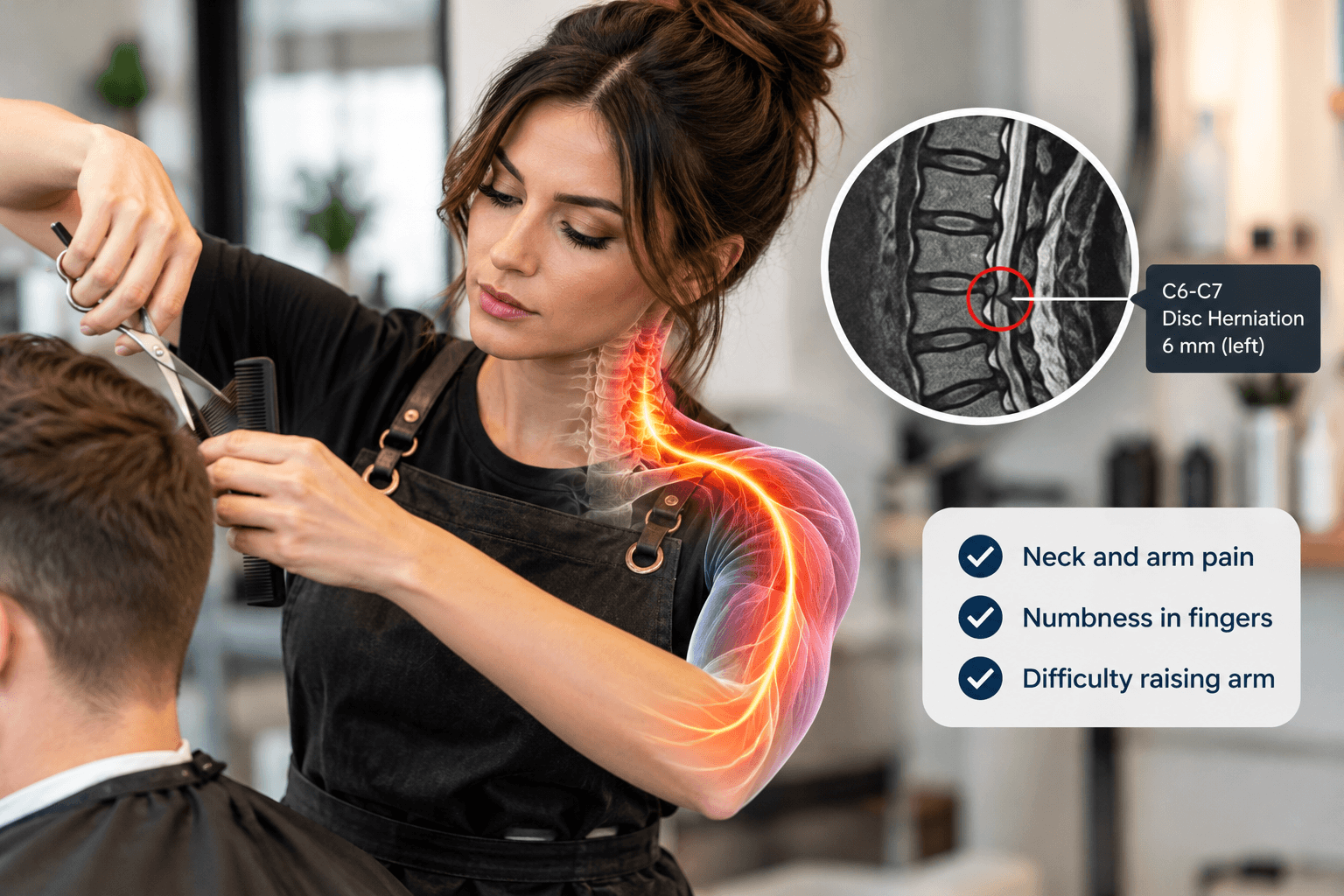
Illustration of the cervical disc and arm symptoms experienced by a barber treated at Venn Chiropractic and Wellness Center in Frisco, TX. Not the patient’s actual MRI.
Facing Cervical Fusion After a C6-C7 Disc Herniation: A Frisco Barber’s Recovery Story
Patient case study | Venn Chiropractic and Wellness Center | Frisco, Texas
At 31 years old, she was facing a decision she never imagined having to make: undergo cervical spine surgery or risk losing the ability to continue working in the career she loved.
She was a barber, and her left arm had become increasingly painful and difficult to use. Neck pain traveled through her left shoulder, down her arm, and into her fingertips. She had developed numbness in her fingers, and raising her arm above shoulder height had become extremely difficult.
After approximately a year of chiropractic adjustments and rehabilitation without lasting improvement, an MRI revealed a 6 mm left-sided disc herniation at C6-C7. She had also experienced a significant worsening of symptoms during a trial of cervical spinal decompression at her previous provider’s office.
Eventually, a neurosurgeon recommended an anterior cervical discectomy and fusion (ACDF).
She wasn’t ready to proceed with surgery without exploring whether another appropriate option existed. A close friend’s recommendation brought her to Dr. Jason Venn at Venn Chiropractic and Wellness Center in Frisco, Texas.
What followed was a carefully individualized treatment plan involving precise Gonstead chiropractic care, non-surgical cervical spinal decompression, and targeted rehabilitation.
Over approximately four months, she reported a progressive recovery that allowed her to return to working comfortably, without neck or arm pain and without the functional limitations that had threatened her career.
Case Overview: Cervical Disc Herniation, Arm Weakness, and a Surgical Recommendation
- Patient: 31-year-old female barber
- Primary symptoms: Neck pain radiating into the left shoulder, arm, and fingertips; finger numbness; painful shoulder movement; reduced arm strength
- MRI finding: 6 mm left-sided C6-C7 disc herniation
- Previous care: Approximately one year of chiropractic care and rehabilitation, including an unsuccessful trial of cervical decompression
- Surgical consultation: Anterior cervical discectomy and fusion (ACDF) recommended
- Initial examination: Reduced left grip strength, decreased left shoulder abduction strength, limited cervical movement, and painful shoulder elevation
- Care at Venn Chiropractic: Specific Gonstead adjustments, individualized cervical spinal decompression, and targeted shoulder rehabilitation
- Reported outcome: Pain resolution, restored functional strength and movement, and return to comfortable work over approximately four months
- Current status: Continues to report no pain or functional problems and elects periodic wellness visits
How Her Symptoms Began—and Why They Became So Disruptive
Her symptoms started suddenly one morning.
She woke up with neck discomfort and pain extending into her left shoulder and arm. Initially, the pain wasn’t severe enough to make her think something serious was wrong.
Over the following weeks, however, it continued getting worse.
The discomfort eventually traveled down her arm toward her fingertips, and she began experiencing numbness in her fingers.
Then she noticed a particularly concerning problem: she was having difficulty raising her left arm.
Once her hand reached approximately shoulder height, lifting it farther became painful and difficult. She began using compensatory movements to accomplish tasks that had previously been effortless.
For most people, that would interfere with everyday activities. For a barber, it threatened her livelihood.
Her work required her to raise her arms, position her hands precisely, and maintain shoulder control throughout the day. She continued cutting hair, but every workday became a challenge.
She worried that if the problem continued progressing, she might eventually have to leave the profession she loved.
Why Her Previous Treatment Wasn’t Producing the Results She Needed
Before developing these symptoms, the patient had been receiving chiropractic wellness care for several years.
When the neck and arm pain began, she naturally returned to the chiropractor she already knew and trusted.
Her treatment involved chiropractic adjustments approximately three times per week, along with physical therapy provided at the same office.
Despite following the recommended treatment schedule, her symptoms continued worsening before eventually stabilizing at a painful, limiting level.
She trusted her provider and remained hopeful that more treatment would eventually help.
An MRI Revealed a 6 mm Herniated Disc at C6-C7
After approximately three months of care, her chiropractor ordered a cervical MRI.
The imaging revealed a 6 mm disc herniation at C6-C7 protruding toward the left.
This was an important finding because cervical herniated discs can irritate or compress nearby nerve roots, potentially producing symptoms that extend beyond the neck.
Depending on the nerve structures involved, patients may experience radiating arm pain, numbness, tingling, or weakness.
In her case, the MRI finding was considered alongside the left-sided symptoms and physical examination findings.
Her Previous Decompression Experience Made Her Symptoms Worse
Following the MRI, cervical spinal decompression was added to her treatment plan.
Unfortunately, the patient reported that she felt significantly worse after the first session.
She was encouraged to continue and completed five additional treatments, but experienced no improvement. By her account, her symptoms were worse than before beginning decompression.
She eventually discontinued that treatment while continuing chiropractic care and rehabilitation.
The exact cause of her worsening symptoms during those sessions cannot be determined from her history alone. However, her experience made her understandably apprehensive about undergoing cervical decompression again.
As time passed, she became increasingly concerned about her arm strength and mobility.
A Neurosurgeon Recommended ACDF Surgery
After approximately a year of unsuccessful treatment, the patient decided she needed another opinion.
She consulted a neurosurgeon, who recommended an anterior cervical discectomy and fusion, commonly called ACDF.
ACDF is a surgical procedure in which the affected cervical disc is removed and the involved spinal segment is stabilized through fusion.
According to the patient’s history, the surgeon recommended proceeding promptly and advised her against further chiropractic care.
She was frightened, frustrated, and uncertain about what to do.
She had spent months faithfully following treatment recommendations, yet her pain and arm dysfunction remained.
At only 31, she was now considering cervical fusion surgery while worrying about her ability to continue working.
Although surgery can be appropriate and sometimes necessary for cervical disc conditions—especially when neurological function is deteriorating—she wanted to explore whether another conservative treatment option might be appropriate for her.
A close friend recommended Dr. Jason Venn, explaining that his Gonstead approach involved a different style of spinal evaluation and treatment.
That conversation led her to schedule a consultation at Venn Chiropractic and Wellness Center.
Dr. Venn’s Evaluation: The MRI Was Only Part of the Picture
When she arrived at the office, Dr. Venn began with an extensive consultation.
He wanted to understand her symptoms, the progression of her condition, the treatment she had already received, and the functional limitations affecting her life.
Most importantly, he wanted to understand her goals.
She wasn’t simply hoping to reduce neck pain. She wanted to regain the ability to raise and use her arm comfortably so she could continue working as a barber.
Her MRI had already documented the C6-C7 disc herniation. Dr. Venn also obtained standing digital X-rays to assess spinal alignment in a weight-bearing position.
He then evaluated cervical movement, shoulder function, and strength.
Objective Findings: Reduced Grip and Shoulder Abduction Strength
The examination revealed several important abnormalities:
- Left grip strength: Measurably reduced compared with the right hand
- Left shoulder abduction strength: Noticeably weaker than the right side during testing
- Cervical rotation: Markedly restricted when turning her head to the left
- Cervical lateral flexion: Reduced toward the left
- Left shoulder abduction: Painful and limited, particularly above shoulder height
- Movement compensation: Visible guarding and recruitment of other muscles to help raise the arm
These findings were especially significant because they demonstrated functional weakness in addition to pain.
Her difficulty using the left arm wasn’t merely a subjective complaint. The strength differences were evident during examination.
The combination of radiating symptoms, MRI findings, and weakness warranted careful neurological assessment and consideration of the neurosurgeon’s recommendation.
Dr. Venn also examined how individual cervical and upper thoracic spinal segments were moving.
That examination revealed a finding that influenced his approach to treatment.
The Gonstead Difference: Identifying the Restricted Segment
During his Gonstead spinal examination, Dr. Venn identified marked restriction around the C7-T1 region.
In contrast, the adjacent C5 and C6 segments appeared comparatively mobile during his assessment.
This distinction was important to his clinical reasoning.
Rather than performing a general cervical adjustment across multiple levels, he selected the specific segment he believed required correction.
His Gonstead assessment guided both the location and direction of the adjustment.
For this patient, Dr. Venn performed a targeted adjustment at C7, directed primarily forward from the left side, without rotational manipulation.
The patient immediately reacted:
“What was that?! That felt different!”
After standing up, she described an unfamiliar sense of ease.
Her symptoms had not completely disappeared, but she felt noticeably different from the way she had felt before the adjustment.
That response was encouraging, although a single treatment response could not establish the long-term outcome.
The larger goal remained restoring her neurological and functional status over time.
Why Dr. Venn Included Cervical Spinal Decompression
Following the adjustment, Dr. Venn discussed cervical spinal decompression with the patient.
She was understandably nervous because her previous experience had made her symptoms substantially worse.
Dr. Venn reviewed that history and explained how he would individualize the treatment parameters based on her clinical presentation and response.
Rather than using a generic setting, the decompression protocol was selected specifically for her.
How Non-Surgical Cervical Decompression Is Intended to Work
Non-surgical spinal decompression uses controlled decompression and release cycles to create a pumping action at the disc.
The treatment is intended to reduce pressure within the affected disc region and encourage fluid movement in disc tissue, which has limited direct blood supply.
For appropriately selected patients, reducing mechanical irritation may help relieve disc-related symptoms.
The patient reported feeling noticeably better after her first session at Venn Chiropractic.
She was surprised by the improvement because she had already undergone extensive previous treatment without meaningful relief.
Her initial response helped guide continued monitoring, but the full treatment plan was evaluated through repeated assessments of pain, movement, strength, and function.
Cervical decompression is not appropriate for every patient with a herniated disc, and its effectiveness varies. Patients with neurological deficits require careful evaluation and appropriate medical or surgical referral when indicated.
The Treatment Plan: Gonstead Chiropractic, Decompression, and Rehabilitation
Dr. Venn developed a treatment plan tailored to the patient’s examination findings and functional goals.
Initially, care was scheduled three times per week and involved three complementary approaches.
1. Precise Gonstead Chiropractic Adjustments
Chiropractic treatment focused on the spinal segments identified during Dr. Venn’s examination.
The purpose was to address relevant joint dysfunction through specific adjustments rather than routinely treating multiple cervical levels.
2. Individualized Cervical Spinal Decompression
Because of the patient’s documented disc herniation and radiating symptoms, cervical decompression was a primary component of the treatment plan.
Settings and patient response were monitored throughout care.
3. Targeted Shoulder and Functional Rehabilitation
Her prolonged symptoms had significantly affected the way she used her left shoulder and arm.
Corrective rehabilitation focused on improving shoulder stability, restoring comfortable range of motion, and addressing the strength differences observed during examination.
Exercises were selected to progressively challenge the smaller stabilizing muscles involved in controlled shoulder movement.
This component was particularly important because her occupation required sustained and repetitive use of her arms.
The plan was not simply to make her neck feel better. It was to help her return to the physical demands of her career.
Her Recovery Timeline: Four Months of Progressive Improvement
Month One: Pain Improved Approximately 90%
At her first monthly reassessment, the patient reported that her pain had improved by approximately 90%.
Her cervical range of motion was considerably better, although still restricted.
Her shoulder was also beginning to move farther without pain, but improvement in shoulder function was progressing more gradually.
Dr. Venn continued monitoring the differences between symptom relief and restoration of movement and strength.
Month Two: Neck Pain Gone and Arm Pain Nearly Resolved
At the second reassessment, the patient reported no remaining neck pain.
Her cervical range of motion had improved to an estimated 85% of normal.
Her arm pain was nearly gone, and her shoulder movement and strength continued improving.
She was much more comfortable, but her functional recovery was still underway.
Month Three: Arm Pain Gone, With Some Weakness Remaining at Work
By the third month, her neck continued to feel excellent.
Cervical movement was nearly symmetrical from side to side.
She reported no arm pain, and her shoulder range of motion was approaching normal.
However, she still noticed some weakness when using her left arm during her workday.
That remaining limitation mattered because her job required repetitive shoulder and arm activity.
Care and rehabilitation continued with attention to restoring comfortable, functional movement.
Month Four: Back to Work Without Pain or Functional Limitations
At approximately four months, the patient’s cervical and shoulder ranges of motion were comparable from side to side.
She reported that her left arm strength felt normal again.
Most importantly, she was working comfortably as a barber without pain or fear that her arm would interfere with her job.
She reported:
- No neck pain
- No radiating arm pain
- Restored cervical and shoulder movement
- Return of normal-feeling arm strength
- Ability to perform her work without the previous limitations
Her functional recovery was especially meaningful because she had arrived worried about losing the career she loved.
These findings describe her clinical course and reported recovery. They do not establish that the disc herniation disappeared on MRI or that every patient with similar findings can avoid surgery.
What Happened After Her Recovery?
After reaching her major treatment goals, the patient’s office visits were reduced to approximately once per week.
She chose to continue periodic chiropractic wellness care because she valued how she felt and wanted to maintain her progress.
Some weeks she attended as planned; other weeks, her schedule prevented her from coming in.
She continued reporting that she felt well, without recurring pain or functional limitations.
Dr. Venn also spent time helping her understand how daily habits could support her comfort and mobility.
Workplace Ergonomics and a Five-Minute Home Routine
Because her work involved prolonged standing, repetitive arm use, and frequent shoulder elevation, Dr. Venn discussed practical adjustments to her working habits.
He also reviewed sleep posture and everyday positions that might place unnecessary stress on her neck and shoulders.
She was given a short home exercise program requiring approximately five minutes per day.
The goal was to help her maintain comfortable movement, continue using her arm confidently, and develop habits that supported long-term function.
Her ongoing care became less about treating an active pain problem and more about helping her maintain the activities and quality of life she had regained.
Why This Was a Particularly Challenging Cervical Disc Case
Several features made this case more complex than an uncomplicated episode of neck pain.
She Had Already Completed Extensive Treatment
She had spent approximately a year receiving chiropractic care and rehabilitation without achieving the improvement she needed.
Her previous experience made it important to understand what had already been attempted and reassess her condition carefully.
She Had an MRI-Documented Cervical Disc Herniation
The 6 mm left-sided C6-C7 herniation was a significant imaging finding that had to be considered alongside her symptoms and examination.
Her Weakness Was Demonstrable During Examination
Reduced left grip strength and weaker left shoulder abduction were observed during testing.
Those findings reinforced the need to take her symptoms seriously and assess neurological function carefully.
Patients experiencing new or worsening arm or leg weakness should receive prompt medical evaluation, especially when symptoms are progressive.
ACDF Surgery Had Been Recommended
A neurosurgeon had recommended cervical disc removal and fusion.
Seeking another opinion gave the patient an opportunity to discuss whether any additional conservative treatment options were appropriate, while recognizing the importance of specialist recommendations.
Her Occupation Required Full Use of Her Arm
For a barber, the ability to raise and control an arm throughout the day is essential.
Her recovery goals therefore included more than reducing pain. She needed to regain the movement, endurance, and functional strength necessary to perform her job.
Her Treatment Was Based on Specific Examination Findings
Dr. Venn’s Gonstead assessment identified a restricted spinal region that influenced the adjustment he selected.
His treatment plan also incorporated individualized cervical decompression and targeted shoulder rehabilitation.
The combination was selected according to her presentation rather than using a predetermined treatment plan.
Dr. Jason Venn’s Perspective: When Previous Treatment Hasn’t Worked
By Dr. Jason Venn, DC
“What I remember most about this patient is how much her condition had begun to affect her life.
She was only 31 years old. She loved being a barber, but her neck and arm pain had reached the point where she was afraid she might not be able to continue working.
She had followed treatment recommendations for approximately a year. She had undergone adjustments, rehabilitation, and decompression. She had an MRI showing a cervical disc herniation, and a neurosurgeon had recommended ACDF surgery.
By the time she came to my office, she was frustrated and scared, but she still hoped there might be another appropriate option.
I wanted to understand her entire history and what her examination revealed before deciding how to approach treatment.
My Gonstead examination identified a specific area of restricted motion around C7-T1, while adjacent segments appeared more mobile. That finding influenced the adjustment I selected.
We also incorporated carefully individualized cervical decompression and shoulder rehabilitation because both her disc condition and her loss of arm function were important parts of the clinical picture.
Watching her regain comfortable movement and return to working without pain was incredibly rewarding.
After more than 25 years in practice, I still believe that patients who haven’t improved elsewhere deserve a careful reassessment. Sometimes a different approach may help, and sometimes further medical or surgical care is necessary.
My responsibility is to understand the patient’s condition, make appropriate recommendations, and help them pursue the best available path forward.”
— Dr. Jason Venn, DC, Founder of Venn Chiropractic and Wellness Center
Frequently Asked Questions About C6-C7 Disc Herniation and Arm Weakness
Can a C6-C7 disc herniation cause arm pain and finger numbness?
Yes. A C6-C7 disc herniation can affect nearby cervical nerve structures and contribute to pain, numbness, tingling, or weakness extending into the arm or hand. The exact symptoms depend on which structures are involved.
Can a cervical disc herniation cause grip weakness?
Cervical nerve-root problems can contribute to weakness in muscles supplied by affected nerves, potentially including muscles involved in gripping. Grip weakness can also have other causes, so it requires appropriate examination rather than assuming the disc is responsible.
Does a 6 mm cervical disc herniation always require surgery?
No. The size of a disc herniation alone does not determine whether surgery is necessary. Decisions depend on symptoms, neurological findings, spinal cord involvement, imaging, and the patient’s overall clinical condition. Progressive weakness or signs of spinal cord compression may require urgent surgical evaluation.
What is ACDF surgery?
Anterior cervical discectomy and fusion is a procedure that removes an affected cervical disc and stabilizes the involved spinal level through fusion. It may be recommended for certain cervical disc conditions involving significant nerve or spinal cord compression.
Can someone seek another opinion after ACDF has been recommended?
Yes. Patients may seek another qualified medical opinion to better understand their diagnosis and treatment options. However, a second opinion should not delay urgent care when neurological function is deteriorating or spinal cord compression is suspected.
Why did this patient receive Gonstead chiropractic and cervical decompression?
Dr. Venn selected these approaches based on his examination findings and the patient’s documented disc condition. Gonstead care focused on specific spinal joint findings, while cervical decompression was intended to address disc-related mechanical symptoms. Her response was monitored throughout treatment.
Why was shoulder rehabilitation necessary?
Her symptoms had affected shoulder movement and strength, making it difficult to perform her job. Targeted rehabilitation was included to help restore functional arm movement and improve her ability to work comfortably.
Did her disc herniation heal without surgery?
The patient experienced substantial clinical improvement without undergoing the recommended surgery during the reported treatment period. However, no follow-up MRI findings were provided, so this case does not establish whether the disc herniation itself resolved.
Looking for Answers After Previous Neck or Disc Treatment Hasn’t Helped?
If you’re dealing with persistent neck pain, radiating arm symptoms, or a cervical disc condition that hasn’t improved with previous care, you deserve a thorough evaluation and a clear understanding of your options.
At Venn Chiropractic and Wellness Center in Frisco, Texas, Dr. Jason Venn has more than 25 years of experience evaluating patients with difficult spinal, disc, and nerve-related conditions.
His clinical approach combines precise Gonstead chiropractic, non-surgical spinal decompression, and individualized rehabilitation when appropriate.
Learn more about neck pain treatment in Frisco or contact our office to schedule an evaluation.
Call (972) 668-9200.
Important: New or progressive arm weakness, difficulty walking, loss of hand coordination, or symptoms suggesting spinal cord compression require prompt medical evaluation. New bowel or bladder dysfunction with neurological symptoms warrants emergency assessment. Conservative care is not appropriate for every cervical disc condition.
About this case study: This patient story is published with authorization. It describes one patient’s history, examination findings, treatment course, and reported outcomes. Individual results vary. Improvement in pain and function does not necessarily demonstrate anatomical resolution of a disc herniation, and this case does not establish that chiropractic care or decompression can replace surgery for patients with significant neurological compromise.