
What Does a Chiropractor Actually Check When Evaluating a Child?
Children aren’t simply smaller adults.
Their bodies are growing, their activities change quickly, and the reason a parent brings an infant or child to a chiropractor can be very different from the reason an adult seeks care.
That’s why pediatric chiropractic care should begin with an evaluation—not an assumption that every child needs the same adjustment.
At Venn Chiropractic and Wellness Center in Frisco, Dr. Jason Venn has cared for children and families for more than 25 years. His approach is to first understand why the child is there, evaluate the areas that are relevant, and determine whether chiropractic care is appropriate.
What that evaluation looks like depends heavily on the child’s age and the reason for the visit.
An infant, a growing 7-year-old, and a 15-year-old football player should not be evaluated or adjusted exactly the same way.
Why Do Parents Bring Their Children to a Chiropractor?
There isn’t one reason.
Some parents bring in a child after a fall, sports injury, or other physical stress.
Others notice posture or movement concerns.
An older child or teenager may be experiencing neck pain, back pain, headaches, stiffness, or discomfort related to sports and physical activity.
Parents who already receive chiropractic care themselves may also want their child’s spine and musculoskeletal system evaluated.
Whatever brings the family into the office, the first question isn’t simply:
“Where should we adjust?”
It’s:
“What is going on with this particular child?”
That distinction matters.
What Does Dr. Venn Ask About First?
Before examining the spine, Dr. Venn wants to understand the reason for the visit.
Depending on the child’s age and circumstances, that may include questions about:
- Current symptoms or concerns
- When the problem began
- Falls, injuries, accidents, or sports
- Activities that aggravate the problem
- Previous episodes of pain or injury
- Relevant medical history
- Physical activities and sports participation
- Changes in movement or function the parent has noticed
With older children and teenagers, Dr. Venn can also ask the patient directly what they are feeling and which activities have become uncomfortable or difficult.
That history helps guide the examination.
A young athlete who developed lower-back pain after football practice requires a different evaluation from a child whose parent simply wants a spinal assessment.
What Does a Pediatric Chiropractic Examination Look For?
The examination is adapted to the child’s age, size, symptoms, and reason for being evaluated.
Depending on the situation, Dr. Venn may assess things such as:
- Posture
- Spinal movement
- Areas of restricted joint motion
- Tenderness or discomfort
- Muscle tension
- Movement patterns
- Balance or symmetry when clinically relevant
- Findings related to a recent injury
- Neurological findings when symptoms indicate they should be evaluated
The goal is to gather information that helps explain what the child or parent is reporting.
Dr. Venn uses the Gonstead System, which emphasizes specificity in evaluating the spine rather than simply performing generalized adjustments.
If the examination identifies a spinal joint that is not moving or functioning properly and the finding corresponds with the child’s presentation, Dr. Venn can determine whether a specific chiropractic adjustment may be appropriate.
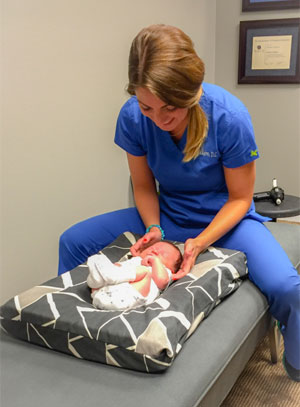
How Are Chiropractic Adjustments Different for Children?
A pediatric chiropractic adjustment should be appropriate for the child’s age, size, development, and individual findings.
An infant obviously does not require the same amount of force that might be appropriate for a full-grown adult.
As children grow, the way they are evaluated and adjusted changes with them.
The purpose, however, remains the same: when Dr. Venn identifies a spinal joint that is not moving or functioning properly and determines that an adjustment is appropriate, the goal is to make a specific correction to that area.
Dr. Venn does not believe in simply adjusting every part of the spine because a child came into the office.
Specificity matters.
With the Gonstead approach, the examination helps determine where a problem appears to be and whether that particular area should be adjusted.
That allows the care to be individualized to the child rather than applying the same routine to every pediatric patient.
Is Chiropractic Care Safe for Children?
This is understandably one of the first questions many parents have.
Chiropractic techniques used with infants and children are modified for their smaller, developing bodies. The amount of force and the way an adjustment is performed should be appropriate for the child’s age, size, and clinical findings.
Just as importantly, safety begins before an adjustment is performed.
The evaluation helps determine whether the child’s presentation appears appropriate for chiropractic care in the first place.
There may be situations where Dr. Venn decides an adjustment isn’t appropriate or where a child’s symptoms warrant evaluation by a pediatrician, orthopedist, or another healthcare professional.
That isn’t a failure of chiropractic care. Knowing when to adjust—and when not to—is part of good clinical judgment.
Does Every Child Who Is Examined Need an Adjustment?
No. An examination and an adjustment are not the same thing.
The purpose of evaluating a child is to determine what is actually present.
If Dr. Venn does not identify a finding that warrants an adjustment, there is no reason to manufacture one simply because the child is already in the office.
Likewise, a child who does need chiropractic care may not require the same areas to be adjusted at every visit.
Findings can change.
This is one reason Dr. Venn evaluates the spine rather than relying on a predetermined adjustment routine.
What About Children Who Play Sports?
Sports can place substantial demands on a growing musculoskeletal system.
Young athletes run, jump, cut, tackle, throw, tumble, lift, and sometimes collide with other athletes or the ground. Even when there isn’t one obvious injury, repeated physical stress can contribute to pain, stiffness, restricted movement, and changes in the way an athlete moves.
When evaluating a young athlete, Dr. Venn wants to understand what happened and what the athlete is having difficulty doing.
Is there pain when running?
Does the back hurt during lifting?
Did symptoms begin after a tackle or fall?
Is neck movement restricted after contact?
Can the athlete perform normally, or has something changed?
The answers help direct the examination toward the structures and movements most relevant to the problem.
When appropriate, specific chiropractic care may help restore normal joint movement, reduce musculoskeletal pain and stiffness, and improve mobility so the athlete can return toward normal activity.
For older children and teenagers who need additional help restoring strength, stability, mobility, or movement after an injury, spinal rehabilitation may also be incorporated when appropriate.
What About Posture and Growing Children?
Children spend considerable time sitting at school, studying, using computers, carrying backpacks, looking at phones, and participating in activities that repeatedly place their bodies in particular positions.
Posture by itself does not mean something is wrong with a child’s spine.
But when posture concerns occur alongside pain, stiffness, restricted movement, or noticeable changes in function, they may be worth evaluating.
Rather than simply telling every child to “sit up straight,” Dr. Venn looks at the individual child and the findings that accompany the concern.
The goal is to determine whether there is an actual musculoskeletal problem that should be addressed rather than treating appearance alone.
Can Chiropractic Help Children With Back or Neck Pain?
Yes. When a child’s back or neck pain is musculoskeletal and the examination identifies spinal joint dysfunction that is appropriate for chiropractic care, chiropractic treatment can be very helpful.
Children can develop back and neck pain for many of the same mechanical reasons adults do.
They can fall.
They can get injured playing sports.
They can strain themselves during physical activity.
They can experience repetitive stress.
Older children and teenagers may also begin lifting weights, participating in more demanding sports, or spending long periods studying and using computers.
The important part is determining why the child hurts.
Dr. Venn evaluates the history, movement, spinal function, and other relevant findings rather than treating every episode of pediatric back or neck pain exactly the same way.
When a specific spinal problem is identified, an age-appropriate chiropractic adjustment can be used to restore movement to the involved joint, reduce pain and stiffness, and improve function.
What About Headaches in Children and Teenagers?
Headaches in children deserve to be taken seriously because there are many possible causes.
At the same time, some headaches can have a musculoskeletal component involving the neck.
An older child or teenager may describe headaches that occur along with neck pain, stiffness, restricted movement, or symptoms that seem to follow physical activity, prolonged studying, computer use, or a previous injury.
In those situations, Dr. Venn can evaluate the cervical spine and surrounding musculoskeletal structures to determine whether neck dysfunction may be contributing.
When clinically relevant spinal findings are present, specific chiropractic care may be an appropriate part of treatment.
A child with new, severe, unusual, persistent, or otherwise concerning headaches may need evaluation by a pediatrician or another medical provider, depending on the presentation.
Patients can learn more about how Dr. Venn approaches headaches and migraines.
What About Babies and Very Young Children?
Evaluating an infant is obviously different from evaluating a teenager.
A baby cannot describe pain, explain what movement bothers them, or answer questions about how symptoms began.
That means the history provided by the parent and the age-appropriate physical examination become particularly important.
Dr. Venn considers why the parent brought the infant in, relevant birth and health history, concerns the parent has noticed, and findings from the examination.
Any chiropractic technique used with an infant should be modified appropriately for the baby’s size and stage of development.
And just as with an older child, an infant should not automatically be adjusted simply because the parent requested an examination.
The decision should be based on the individual findings.
Can Chiropractic Treat Colic, Ear Infections, Reflux, or Digestive Problems?
This is an important question because these conditions are frequently discussed in connection with pediatric chiropractic.
Parents sometimes bring infants or children to chiropractors while the child is experiencing colic, recurrent ear infections, reflux, constipation, digestive symptoms, sleep difficulties, or other health concerns.
However, those conditions should not automatically be attributed to a spinal problem.
An ear infection is not simply evidence that a child’s spine needs adjusting. Neither are reflux, constipation, colic, or difficulty sleeping.
Dr. Venn’s role as a chiropractor is to evaluate the child’s spine and musculoskeletal system and determine whether there is a chiropractic finding that is appropriate to address.
If a child also has a medical condition, appropriate pediatric medical care remains important.
This distinction does not diminish pediatric chiropractic care. It makes the reason for care clearer: identify the musculoskeletal or spinal problem when one is present and treat that problem specifically.
When Should a Child See a Pediatrician Instead?
Chiropractic care and pediatric medical care serve different roles, and there are situations where a pediatrician or another medical professional should be involved.
A child may need medical evaluation for symptoms such as significant fever or signs of infection, unexplained weight loss, difficulty breathing, persistent vomiting, significant neurological changes, suspected fracture, serious trauma, or other symptoms that do not appear musculoskeletal.
Parents also know their children well. A significant unexplained change in a child’s behavior, energy, movement, or overall health deserves attention even when the cause isn’t immediately obvious.
Dr. Venn’s job isn’t to make every childhood complaint fit a chiropractic explanation.
It’s to recognize the problems chiropractic care is well suited to address and recognize when something different may be going on.
That combination of specificity and clinical judgment is especially important when caring for children.
Why Experience Matters With Pediatric Chiropractic Care
Caring for children requires more than simply using less force than you would with an adult.
It requires understanding how the examination and treatment need to change with the child’s age, size, development, symptoms, and activities.
Dr. Jason Venn has practiced in Frisco since 2000 and has more than 25 years of chiropractic experience. During that time, he has cared for patients across different stages of life, including infants, children, teenagers, athletes, adults, and families.
That experience matters because pediatric patients can present very differently.
A young child who took a hard fall, a middle-school athlete with back pain, and a teenager with neck pain and headaches may all require different examinations and different clinical decisions.
The goal isn’t to fit the child into a standard pediatric treatment protocol.
It’s to determine what that individual child needs.
What Should Parents Expect at a Pediatric Chiropractic Visit?
The visit begins with understanding why the child is there.
Dr. Venn will discuss the concern with the parent and, when the child is old enough, with the child as well.
The examination is then tailored to the child’s age and reason for the visit.
If Dr. Venn identifies a spinal or musculoskeletal problem that is appropriate for chiropractic care, he can explain what he found, why he believes it is relevant, and what he recommends.
If a chiropractic adjustment is appropriate, the technique and amount of force are adapted to the child.
And if the findings do not indicate that chiropractic treatment is necessary—or suggest that another type of evaluation should come first—that should guide the recommendation as well.
Parents who want to learn more about care for infants, children, and teenagers can visit our pediatric chiropractic care in Frisco page.
Frequently Asked Questions About Pediatric Chiropractic
What Age Can a Child See a Chiropractor?
There isn’t one universal age at which chiropractic evaluation suddenly becomes appropriate.
Infants, children, and teenagers can be evaluated, but the examination and any treatment provided should be appropriate for the child’s age, size, development, and individual findings.
The question is less about reaching a particular age and more about why the child is being evaluated and whether chiropractic care is appropriate for that child.
Are Children’s Chiropractic Adjustments the Same as Adult Adjustments?
No.
Children are smaller and still developing, so chiropractic techniques should be adapted appropriately.
An infant should not receive the same adjustment or amount of force that might be appropriate for an adult.
As children grow, the approach changes according to their size, development, clinical findings, and reason for care.
Does My Child Have to Be in Pain to See a Chiropractor?
Not necessarily.
Parents sometimes notice changes in movement, posture, mobility, or function, or they may want a child evaluated after a fall, collision, or other physical stress even when the child isn’t reporting significant pain.
An evaluation can determine whether there is a relevant musculoskeletal or spinal finding rather than assuming that an adjustment is needed.
Does Every Pediatric Chiropractic Visit Include an Adjustment?
No. An examination determines whether an adjustment is appropriate.
Dr. Venn’s goal is not to adjust a child simply because they came into the office. Treatment should be based on the child’s current findings.
Can Young Athletes Benefit From Chiropractic Care?
Yes. Young athletes can experience musculoskeletal pain, restricted joint movement, stiffness, and injuries related to training, competition, falls, collisions, and repetitive physical demands.
When the examination identifies a problem appropriate for chiropractic care, specific adjustments can help restore joint movement, reduce pain and stiffness, and improve function.
Depending on the athlete and condition, rehabilitation may also be incorporated to address strength, stability, mobility, or movement.
Pediatric Chiropractic Care in Frisco, TX
Children are active, growing, and constantly placing new demands on their bodies.
When something hurts or isn’t moving or functioning normally, the answer shouldn’t automatically be an adjustment—but chiropractic care shouldn’t be dismissed simply because the patient is young, either.
The right starting point is an appropriate evaluation.
At Venn Chiropractic and Wellness Center, Dr. Jason Venn evaluates each child individually and uses age-appropriate chiropractic care when the findings indicate it is appropriate.
The goal is specific care for the problem that is actually present—not a one-size-fits-all pediatric treatment plan.
If you’d like to have your child’s spine or musculoskeletal system evaluated, schedule an evaluation with Venn Chiropractic and Wellness Center.