
If you’re considering spinal decompression, you may already understand why it has been recommended—but still have questions about what actually happens during treatment.
Does spinal decompression hurt? What does the table feel like? Will you feel your spine being pulled? How long does treatment take? And what should you expect afterward?
These are important questions because spinal decompression is not simply a treatment someone should receive because they have back pain, neck pain, or a disc problem. At Venn Chiropractic and Wellness Center in Frisco, Dr. Jason Venn first evaluates the patient’s symptoms, examination findings, spinal condition, and imaging when appropriate to determine whether decompression should be considered.
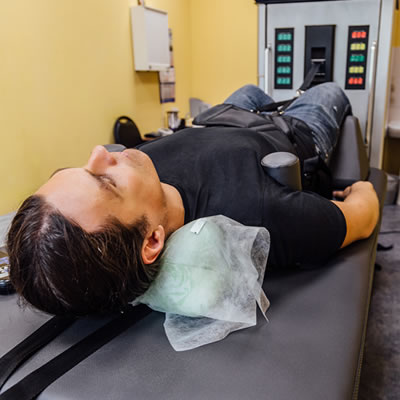
For patients who are appropriate candidates, treatment is performed on a specialized decompression table that applies controlled distraction to a targeted region of the spine. The amount of force, positioning, and treatment parameters can be adjusted according to the individual patient and treatment plan.
Many patients describe the treatment as a gentle pulling or stretching sensation rather than a painful one. Individual experiences can vary, however, and how a patient responds to treatment is something Dr. Venn monitors throughout care.
Quick Answer: What Does Spinal Decompression Feel Like?
Spinal decompression typically feels like a controlled, gradual pulling or stretching sensation through the area being treated. The patient remains supported on the treatment table while the system applies and releases distraction according to the treatment settings.
Treatment should not simply be about tolerating as much force as possible. The goal is to use an appropriate treatment protocol for the individual patient while monitoring symptoms and response over time.
Some patients find the experience comfortable or relaxing, while others may notice temporary soreness or changes in their familiar symptoms as treatment begins. A significant or unexpected increase in symptoms should be communicated so the patient’s response can be evaluated and the treatment plan adjusted when appropriate.
What Happens During a Spinal Decompression Treatment?
Before spinal decompression begins, the treatment should be based on what was found during the patient’s evaluation. Two people may both have lower back pain or a disc problem, but that does not mean they should automatically receive the same treatment or decompression protocol.
At Venn Chiropractic and Wellness Center, Dr. Venn considers the patient’s symptoms, examination findings, imaging when appropriate, and the area of the spine being treated before determining how decompression will be used.
Getting Positioned on the Decompression Table
The patient is positioned on a specialized decompression table and supported so treatment can be directed to the appropriate region of the spine. Proper positioning matters because the goal is to apply controlled distraction to the area being treated rather than simply pulling on the entire spine.
Once the patient is positioned comfortably, the treatment parameters are set according to the individual treatment plan.
The Treatment Begins Gradually
During treatment, the decompression system applies controlled distraction in a gradual manner. Patients commonly describe this as a pulling, stretching, or unloading sensation through the treated area.
The force is not intended to be a test of how much a patient can tolerate. More force does not automatically mean a better treatment.
Dr. Venn monitors how the patient responds and can modify the treatment approach when necessary. This is particularly important when treating someone with a herniated or bulging disc, significant degeneration, or symptoms that extend into an arm or leg.
What Should You Feel During Treatment?
The experience can vary from patient to patient.
Some people notice a gentle stretching sensation and become very relaxed during treatment. Others are more aware of the pulling sensation, particularly during their first few sessions when the experience is unfamiliar.
What Dr. Venn does not want is for a patient to simply remain silent and endure a significant increase in pain, numbness, tingling, or other concerning symptoms. Changes in symptoms provide information about how the patient is responding and should be communicated.
This is one reason spinal decompression at Venn Chiropractic is incorporated into an individualized treatment plan rather than treated as a stand-alone machine protocol.
What Happens When the Session Is Finished?
How someone feels immediately afterward can vary as well. Some patients may notice that an area feels different, looser, or temporarily more comfortable. Others may experience some soreness, particularly as treatment is introduced or adjusted.
The response to one session does not necessarily determine whether treatment is succeeding or failing. Dr. Venn looks at the pattern over time—including changes in symptoms, neurological findings when relevant, mobility, function, and the patient’s ability to return to normal activities.
If symptoms respond differently than expected, that information can be used to reevaluate or modify the treatment plan rather than simply repeating the same protocol.
Does Spinal Decompression Hurt?
Spinal decompression is generally intended to be a controlled and tolerable treatment, but every patient can respond differently. Some people find the stretching sensation comfortable or relaxing, while others may notice temporary soreness or increased sensitivity, particularly when treatment is first introduced.
The important distinction is between a temporary response to treatment and a meaningful change in symptoms that deserves attention.
Is Soreness After Spinal Decompression Normal?
Some patients may experience temporary soreness or stiffness after a spinal decompression session. This does not automatically mean something has gone wrong, but it also should not simply be ignored if symptoms are significant or continue to worsen.
Dr. Venn considers what the patient felt during treatment, how symptoms changed afterward, and whether the response follows an expected pattern for that individual.
For example, an increase in familiar soreness may provide different information than new or increasing numbness, tingling, weakness, or pain traveling farther into an arm or leg.
What If Your Symptoms Feel Worse After Treatment?
A temporary increase in symptoms does not automatically mean that decompression has failed—or that treatment should simply continue unchanged.
The response itself provides information.
If symptoms increase, Dr. Venn can reassess how the patient responded and determine whether the treatment parameters should be modified, whether more recovery time is appropriate, or whether the clinical picture needs to be reevaluated.
This is one reason treatment response matters alongside the original examination and imaging findings. The plan can evolve as more information becomes available about how the patient is responding.
How Do You Know If Spinal Decompression Is Helping?
Improvement should not be judged solely by how someone feels immediately after getting off the table.
Depending on the condition being treated, Dr. Venn may look at the broader pattern over time. That can include changes in pain frequency or intensity, where symptoms are traveling, numbness or tingling, mobility, strength when relevant, activity tolerance, sleep, and the ability to perform normal daily activities.
For patients receiving decompression as part of care for sciatica, for example, changes in the pattern of leg symptoms may provide useful information in addition to changes in lower back pain.
The goal is not to chase a temporary feeling after every session. It is to determine whether the overall clinical and functional picture is moving in the right direction.
How Is Spinal Decompression Different From Traditional Traction?
Spinal decompression and traditional traction are sometimes discussed as though they are the same treatment, but there is an important difference in how the force is applied.
Traditional traction generally relies on a pulling or stretching force applied to the spine. Spinal decompression uses controlled cycles of distraction and relaxation rather than simply maintaining a continuous pull.
Dr. Venn often explains the difference by thinking of decompression as a pumping action.
During treatment, the decompression system gradually increases distraction and then reduces it in repeated cycles. Instead of simply pulling harder and holding the spine there, these changing forces create a rhythmic unloading and reloading effect through the treated spinal segment.
Why Does the Pumping Action Matter?
Intervertebral discs do not have the same direct blood supply found in many other tissues. Movement of fluid and nutrients occurs partly through diffusion and changes in mechanical loading.
The alternating distraction and relaxation used during decompression is intended to create repeated changes in pressure and loading within the treated area. Think of it somewhat like gently squeezing and releasing a sponge: changes in pressure can influence the movement of fluid rather than simply holding the tissue in one stretched position.
This is the reason Dr. Venn describes decompression as more of a pumping process than a stretching treatment.
It is also important not to overstate what that means. Decompression does not physically “push a disc back into place,” and a patient feeling better after treatment does not prove that a herniation has retracted. The purpose is to create a controlled mechanical environment that may reduce loading on sensitive spinal structures and may help selected patients with certain disc-related and degenerative conditions.
Why Doesn’t Dr. Venn Simply Use More Force?
Because the objective is not to stretch the spine as far as possible.
The amount of distraction needs to be appropriate for the patient, the region being treated, and how that patient responds. More force does not automatically create a better pumping effect or a better clinical result.
This is also why the patient’s response matters throughout care. If symptoms change significantly, Dr. Venn can reconsider the treatment parameters rather than simply continuing to increase the force.
Is Spinal Decompression the Only Treatment Patients Receive?
Not necessarily.
When appropriate, decompression may be combined with specific Gonstead chiropractic adjustments. The two treatments have different purposes: decompression provides the controlled distraction-and-relaxation cycles, while a Gonstead adjustment is directed at specific spinal joint findings identified during the examination.
As symptoms and function improve, spinal rehabilitation may also be incorporated to address mobility, strength, stability, and return to normal activity.
Which components are used depends on the patient’s examination, condition, response to care, and goals rather than following the same protocol for everyone.
Why Evaluation Comes Before Decompression
Back pain, neck pain, numbness, tingling, and radiating arm or leg symptoms can have many possible causes. Having one of these symptoms—or even having a disc abnormality on imaging—does not automatically mean someone needs spinal decompression.
Dr. Venn first evaluates the clinical picture and then determines whether decompression is appropriate. The table is a treatment tool; it does not make the diagnosis.
Who Is Spinal Decompression Appropriate For?
Spinal decompression is not a treatment for every person with back pain, neck pain, or an abnormal finding on an X-ray or MRI. Whether it should be considered depends on the condition involved, the patient’s symptoms, examination findings, and whether the clinical picture suggests that reducing mechanical stress on certain spinal structures may be appropriate.
At Venn Chiropractic and Wellness Center, Dr. Venn uses the evaluation to determine whether decompression belongs in the treatment plan rather than starting with the assumption that every patient with a disc problem needs it.
What Conditions May Be Considered for Spinal Decompression?
Depending on the individual patient and clinical findings, spinal decompression may be considered as part of conservative care for conditions such as:
- Herniated or bulging discs
- Degenerative disc changes
- Sciatica associated with certain lumbar conditions
- Spinal stenosis in selected patients
- Certain types of neck or back pain associated with disc and degenerative changes
Having one of these diagnoses does not automatically make someone a good candidate. Two patients can have similar findings on imaging and respond very differently because their symptoms, neurological findings, overall health, and functional limitations may not be the same.
What About Neck and Arm Symptoms?
Decompression is not limited to the lower back. Cervical decompression may be considered for selected patients when the evaluation suggests that a condition in the neck may be contributing to symptoms.
This is particularly important because shoulder or arm pain does not always originate in the shoulder itself. Burning, tingling, numbness, weakness, or pain traveling into an arm can sometimes be associated with irritation of a cervical nerve root.
Our Shoulder Pain or a Neck Problem? cervical nerve case study shows a real example of why identifying where symptoms are coming from matters before deciding how to treat them.
Who May Not Be a Candidate?
There are situations in which spinal decompression may not be appropriate or additional medical evaluation may be needed first. This is one reason candidacy should be determined individually rather than from a symptom checklist or imaging report alone.
A patient’s medical history, current condition, neurological findings, previous procedures or surgeries, bone health, and other clinical factors can affect whether decompression should be considered.
If Dr. Venn’s evaluation suggests that decompression is not appropriate—or that a patient’s symptoms require another type of testing or medical evaluation—the next step should reflect those findings rather than trying to make the patient fit the treatment.
What If You Have an MRI Showing a Disc Problem?
An MRI showing a bulging or herniated disc can provide valuable information, but the image is only one part of the clinical picture.
Disc abnormalities are not always symptomatic. Dr. Venn considers whether the location and nature of the imaging findings make sense when compared with the patient’s pain pattern, neurological findings, function, and examination.
The same principle applies to digital X-rays. X-rays can provide useful structural information about alignment, disc-space narrowing, degeneration, osteophytes, and other findings, but they do not directly show a pinched nerve or establish that a particular finding is responsible for someone’s symptoms.
The purpose of imaging is to add information to the evaluation—not replace it.
Frequently Asked Questions About Spinal Decompression Treatment
How long does a spinal decompression session take?
The length of a spinal decompression session can vary depending on the treatment plan and the area being treated. Rather than focusing only on the number of minutes spent on the table, the treatment parameters should be selected according to the individual patient and adjusted when appropriate based on response.
Dr. Venn will explain what to expect from your particular treatment schedule before care begins.
What should I wear for spinal decompression?
Comfortable clothing that allows you to lie comfortably on the decompression table is generally a good choice. If your clothing or accessories could interfere with positioning or treatment, the Venn Chiropractic team can let you know what needs to be adjusted or removed before the session begins.
Can you feel the spine being pulled during decompression?
Most patients are aware of some degree of pulling or stretching during treatment. However, decompression is not intended to simply pull the spine and hold it there.
The treatment uses controlled cycles of distraction and relaxation, creating the pumping action Dr. Venn uses to explain the difference between decompression and traditional traction. The sensation can vary according to the area being treated, the treatment parameters, and the individual patient.
Can you be sore after spinal decompression?
Some patients may experience temporary soreness or stiffness after treatment. How someone responds can vary, particularly when decompression is first introduced or treatment parameters change.
Significant increases in pain or new or worsening neurological symptoms should be communicated rather than simply assumed to be a normal part of treatment.
How many spinal decompression treatments will I need?
There is no single number of treatments that is appropriate for everyone.
The recommended treatment plan depends on factors such as the condition being treated, symptom severity and duration, examination and imaging findings, neurological involvement when present, functional limitations, and how the patient responds to care.
Dr. Venn monitors progress throughout treatment rather than assuming every patient should receive the same number of sessions.
How quickly does spinal decompression work?
There is no reliable timeline that applies to every patient. Some people may notice changes relatively early in care, while others may improve more gradually. A patient’s response can also vary from one visit to another.
Progress should not be judged only by whether someone feels immediate relief after a session. Changes in symptom frequency and distribution, mobility, neurological findings when relevant, activity tolerance, and overall function can provide a more useful picture over time.
Is spinal decompression the same as traction?
No. Although both involve distraction of the spine, the way the force is delivered is different.
Traditional traction generally involves a pulling or stretching force. Spinal decompression uses controlled cycles of distraction and relaxation. Dr. Venn describes this as a pumping action: the changing forces repeatedly unload and reload the treated area rather than simply maintaining a continuous stretch.
For a more complete explanation of how decompression may be used for different spinal conditions, visit our spinal decompression resource.
What to Expect From Spinal Decompression at Venn Chiropractic
Spinal decompression should not begin with getting someone onto a table. It should begin with determining whether the treatment makes sense for that person’s condition.
At Venn Chiropractic and Wellness Center in Frisco, Dr. Jason Venn evaluates the patient’s history, symptoms, examination findings, neurological findings when relevant, and imaging when appropriate before recommending decompression.
For patients who are appropriate candidates, treatment is individualized and the response is monitored over time. Decompression may be used alone or alongside other appropriate care, including specific Gonstead adjustments and rehabilitation, depending on the patient’s findings and goals.
If you are considering spinal decompression and want to know whether it may be appropriate for your condition, the first step is an evaluation.
Wondering If Spinal Decompression Is Right for You?
Back pain, neck pain, sciatica, and disc problems can have different causes, and having one of these symptoms does not automatically mean you need spinal decompression. Dr. Venn can evaluate your symptoms and findings to determine whether decompression—or another approach—may be appropriate for you.